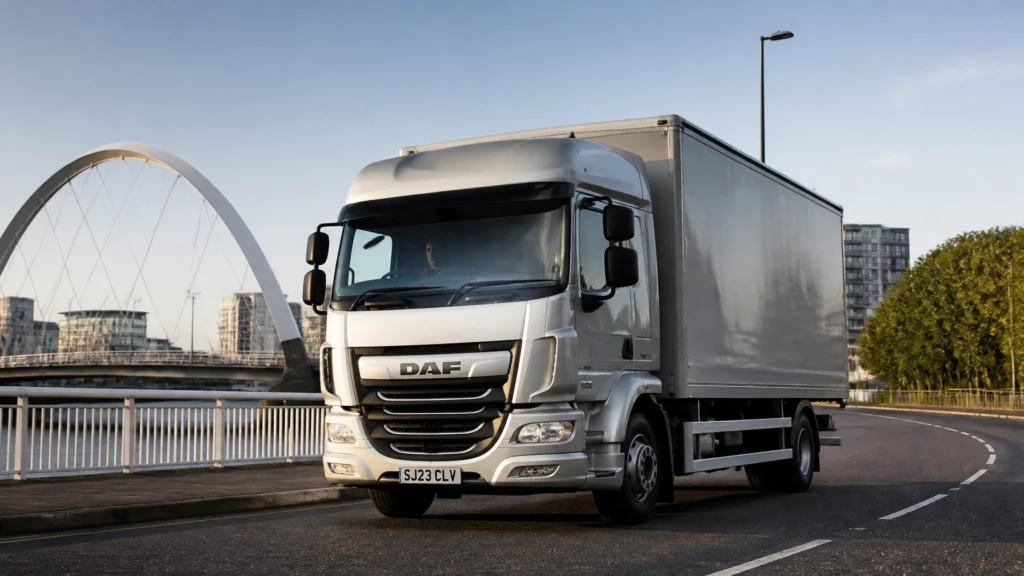
So, you’ve decided to swap the office cubicle or the delivery van for a seat that towers above the M8 traffic. Smart move. Whether you’re looking to boost your earnings or you’ve just always fancied yourself behind the wheel of a 26-tonne beast, getting your class 2 hgv training is the first major step.
But let’s be honest: the thought of a DVSA examiner sitting next to you while you navigate a multi-lane roundabout in the middle of Glasgow is enough to make anyone’s palms a bit sweaty. That’s why we’ve put together this secret playbook. We’re not just talking about how to drive; we’re talking about how to pass first time, save yourself a fortune in re-tests, and get your hgv licence scotland with style.
It’s time to take the bull by the horns and get on the road to a new career. Here is how you master the Class 2 HGV training process in the Dear Green Place.
1. The Paperwork: Don’t Let a Form Stall Your Engine
Before you even touch a steering wheel, you have to deal with the "Devolved Administration" of paperwork. Many students think they can just show up and drive, but the reality is that your journey starts with a D2 and a D4 form.
The HGV Medical Assessment
You can’t drive a heavy goods vehicle if your health isn’t up to scratch. You’ll need an hgv medical assessment where a doctor checks your eyesight, blood pressure, and overall fitness.
- Pro Tip: Don’t just go to your GP and pay a premium. Look for specialized HGV medical providers who do it for half the price.
- Vital Decision: Be honest about any conditions. If you try to hide something now, it’ll only come back to bite you during the DVSA check.
Once the medical is sorted and you’ve sent your license off to Swansea for the provisional entitlement, you’re officially in the game.

2. Cracking the Theory: It’s More Than Just Road Signs
The hgv training glasgow experience isn't all about the open road; it starts at a computer screen. You’ve got three hurdles here:
- Multiple Choice: 100 questions. You need 85 to pass.
- Hazard Perception: Watching CGI clips and clicking when you see danger.
- CPC Case Studies (Module 2): Real-world scenarios about being a professional driver.
Many people underestimate these. They think, "I’ve been driving a car for ten years, how hard can it be?" The answer? Harder than you think. An lgv course theory test covers things you’ve never thought about, like tacho rules, bridge heights, and air brake systems.
The Secret to Success:
Don't just read the book once. Use official DVSA apps and take mock tests until you’re hitting 95% every time. This is where many fail because they rush into the test without enough revision. Remember, failing here delays your practical training and adds to the cost of your hgv courses scotland.

3. Practical Training: Getting To Grips With The Rigid
Once you’ve passed your theory, it’s time for the fun part: the practical training. For Class 2 (Category C), you’ll be driving a "rigid" vehicle. This means the cab and the trailer are one single unit. It’s easier than the hgv training class 1 (C+E articulated trucks), but don't get cocky, it’s still a massive piece of machinery.
The Reversing Maneuver
This is the "make or break" for many students. You’ll be asked to reverse the vehicle into a designated bay.
- The Playbook Move: Use your mirrors. Then use them again. In a car, you can glance over your shoulder. In a Class 2 truck, you are 100% dependent on those mirrors.
- Slow is Pro: The examiner isn't timing you to see how fast you can do it. They want to see control. Creep the vehicle back. If you need to pull forward to straighten up, do it. It’s better to use one of your allowed "shunts" than to hit a cone and fail instantly.
4. Navigating Glasgow: The Local Advantage
Why is hgv training glasgow different from training in, say, a quiet village in the Highlands? Because Glasgow doesn’t play. You’ve got the M8: one of the busiest motorways in Europe: interweaving with complex city junctions and tight industrial estates like Hillington or Baillieston.
Dealing with the M8 and "The Weaving"
The M8 through Glasgow is famous for its "on the right" exits and short slip roads. As an HGV driver, you need to be thinking three steps ahead.
- Positioning is Key: If you know you need the Charing Cross exit, don’t wait until the last second to move.
- Mirror, Signal, Maneuver: This isn't just a catchy phrase; it’s your lifeline. Drivers in Glasgow are often in a rush; they will try to "undertake" you. You must check your blind spots constantly.
The "Wide Swing"
When turning left at a tight Glasgow junction, you often need to swing the front of the truck out to the right to ensure the back wheels don't clip the kerb. Clipping a kerb during your test is a "Major" fault. That’s an immediate fail. Our instructors will teach you exactly how much "room for the boom" you need to leave.

5. The Professional Edge: CPC Training
If you want to drive for a living (and let's face it, that’s why you’re here), you need your CPC periodic training. CPC stands for Certificate of Professional Competence. It’s a legal requirement that proves you aren't just a guy who can drive a truck, but a professional who understands safety, security, and fuel efficiency.
At HGV Training Glasgow, we integrate this into our comprehensive driver training programs. It covers everything from driver hours rules (crucial if you want to keep your license) to how to secure a load so it doesn't end up scattered across the Kingston Bridge.
6. Test Day: Managing the Nerves
On the day of your test, remember: the examiner isn't looking for a perfect driver. They are looking for a safe driver.
- The Walk-Around Check: Treat this like a performance. Be vocal. Check the tires, the lights, the reflectors, and the fluid levels. If you see a small stone stuck in the tread, point it out. It shows you’re paying attention.
- Verbalize Your Thoughts: If you see a cyclist ahead, say, "I’ve seen the cyclist, I’m giving them extra room." It helps the examiner understand your "planning and awareness" without having to guess what you’re thinking.
- Recovery: If you make a mistake: maybe you miss a gear or take a roundabout a bit wider than planned: don’t panic. Take a breath and get back into your rhythm. Many students fail because they make one minor mistake and then let their nerves spiral into a major one.

Why Choose HGV Training Glasgow?
We don't just teach you to pass a test; we prepare you for a career. Glasgow is a massive hub for logistics. With major distribution centers for supermarkets and haulage firms surrounding the city, a class 2 hgv training certificate is basically a golden ticket to employment.
Our high first-time pass rates aren't an accident. They are the result of tailored lesson plans, patient instructors, and the fact that we use modern, industry-standard vehicles. Plus, we don't just wave goodbye once you pass. Our job assistance program helps connect our graduates with local firms looking for fresh talent.
Whether you're looking to start with Category C (Class 2) or you eventually want to progress to the big leagues of Class 1 (C+E), we are here to guide you every mile of the way.
Ready to get behind the wheel?
Don't let another year pass you by in a dead-end job. The road is calling, and the view is much better from the top of an HGV cab.
Take the first step today. Contact HGV Training Glasgow and let's get you moving.
