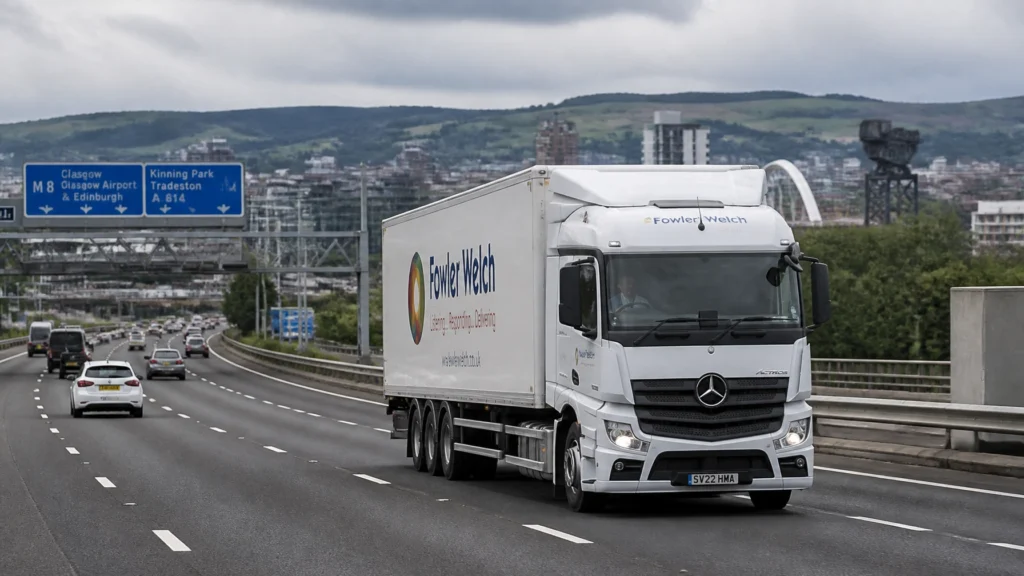
So, you’re thinking about swapping the commuter car for something with a bit more… presence? Trading the morning crawl in a hatchback for a view from the high cab of a 26-tonne rigid truck is a smart move. Glasgow is the beating heart of Scotland’s logistics network, and with the M8, M74, and M80 serving as the arteries of our economy, there’s never been a better time to get behind the wheel.
But before you go charging into a new career, there’s a bit of groundwork to cover. Class 2 HGV training (or Category C, as the DVSA officially calls it) isn't just about learning to steer a bigger vehicle; it’s about mastering a professional craft. Whether you're looking to upgrade your current licence or you're starting from scratch, here are 10 vital things you need to know before you hit the M8.
1. Category C vs. Class 2: It’s the Same Beast
In the industry, we often use the terms interchangeably, but it can be confusing for newcomers. "Class 2" is the old-school term, while Category C is the modern legislative name. This licence allows you to drive rigid vehicles over 3,500kg with a trailer up to 750kg. Think large delivery trucks, refuse vehicles, or fire engines. If you want to go even bigger (articulated lorries), you’ll eventually need your Class 1 (Category C+E), but Class 2 is the perfect foundation.
2. The Medical Assessment is Your First "Green Light"
You can’t just jump in a truck and start practicing. Your journey begins with a D4 medical assessment. A doctor will check your vision, hearing, and general health to ensure you're fit for the demands of professional driving. It might feel like a hurdle, but it’s a necessary provision to keep everyone safe on the road. We can help you arrange these medical assessments as part of your training package, so you aren't left navigating the NHS wait times alone.
3. Paperwork Patience: The D2 and D4 Forms
Once your medical is sorted, you need to apply for your provisional HGV entitlement using the D2 and D4 forms. This goes off to the DVLA, and then… you wait. It usually takes a few weeks for your "shiny" new provisional licence to arrive. This is why we recommend starting this process early. Don't wait until you've booked your week off work; take the bull by the horns and get the paperwork moving now.
4. The Theory Test isn't a Walk in the Park
Think your car theory test was easy? The HGV version is a different kettle of fish. You’ll face 100 multiple-choice questions (Module 1a) and a hazard perception test with 19 clips (Module 1b). You need to understand bridge heights, tachograph rules, and air-braking systems.

This is where many people trip up by being overconfident. For that reason, we provide comprehensive study materials to ensure you’re not just guessing, but actually learning the mechanics of the trade.
5. Don’t Forget the Case Studies (Module 2)
This is a separate part of the Driver CPC (Certificate of Professional Competence). It involves computer-based scenarios that test how you’d handle real-world situations, like securing a load or dealing with an emergency. It’s practical knowledge in a digital format. Passing this is essential if you want to drive professionally and earn a wage, rather than just having the licence for a hobby (and let's be honest, nobody drives a 26-tonner just for the "banter" at the weekend).
6. Intensive Training is the Gold Standard
Most hgv training glasgow courses are "intensive." This usually means 3 to 5 days of solid, in-vehicle instruction. You’ll be paired with a highly experienced and patient instructor who knows the local Glasgow test routes like the back of their hand.

By immersing yourself in the environment, you build muscle memory much faster than you would with one-hour lessons once a week. It’s about getting "truck-fit" in a concentrated burst.
7. Respect the M8: Planning is Everything
Driving an HGV through the Charing Cross section of the M8 isn't like nipping to the shops. You have to account for the "lane drop" junctions, short slip roads, and the sheer volume of traffic. Examiners in Glasgow are looking for "early planning."
This means looking 20 seconds ahead, not just at the bumper in front. If you see a gantry sign for the Kingston Bridge, you need to be in the correct lane long before the traffic thickens. However, don't let the M8 intimidate you; with the right instruction, you’ll learn to navigate these complexities with the calm of a seasoned pro.
8. The "S-Shape" Reversing Manoeuvre (Module 3a)
Before you even go out for your on-road driving test (Module 3b), you have to pass the off-road reversing test. You’ll need to manoeuvre the vehicle into a restricted bay in an "S" shape. It sounds daunting, but it’s all about reference points and slow, controlled speed. Our instructors will show you exactly where to look in your mirrors to ensure you nail it every single time. Remember: slow is smooth, and smooth is fast.
9. CPC Module 4: The Practical Demo
This is often called the "Show Me, Tell Me" on steroids. You’ll be asked to demonstrate things like how to prevent criminal trafficking, how to secure a load with straps, and how to perform a daily walk-around safety check. It’s a hands-on test that proves you can keep yourself, your vehicle, and your cargo safe. It’s a vital part of being a professional driver.
10. Life After the Test: Job Assistance
Passing your test is the beginning of the journey, not the end. The logistics industry in Scotland is crying out for reliable Class 2 drivers. From local multi-drop deliveries to regional haulage, the career progression is fantastic. At HGV Training Glasgow, we don’t just wave you goodbye once you have your certificate; we’re committed to assisting our drivers in securing full-time employment within the haulage industry.

Why Choose HGV Training Glasgow?
We pride ourselves on our high first-time pass rates and our DVSA-registered status. We know that starting a new career can be a bit nerve-wracking, which is why our tailored lesson plans are designed to suit your individual skill level. Whether you’re a van driver looking to level up or someone completely new to the industry, we have the expertise to get you on the road.
The road to a new career starts with a single step: or in this case, a single phone call. If you’re ready to take the bull by the horns and start your lgv course, get in touch today. Let’s get you ready for the M8 and beyond.