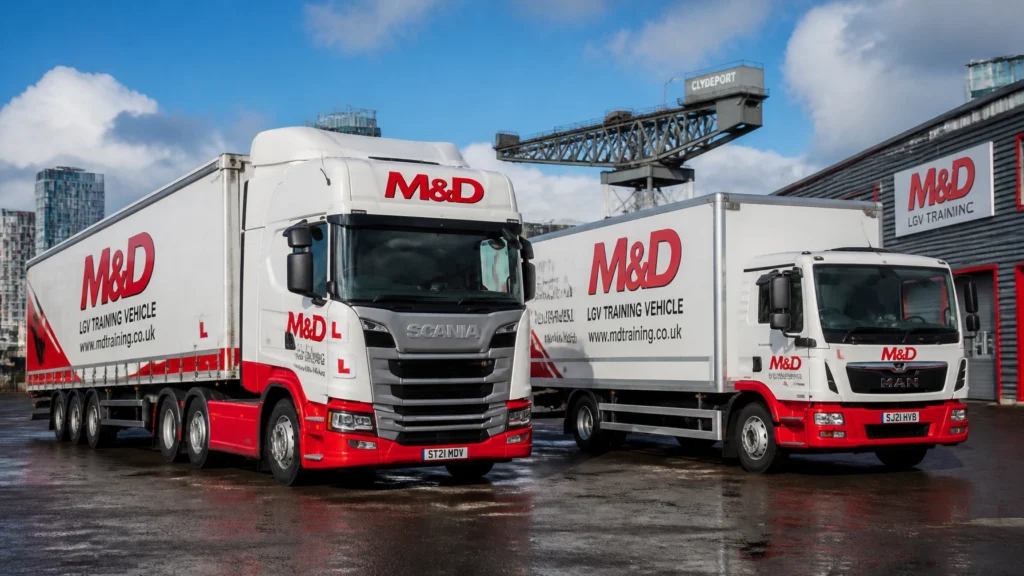
So, you’ve decided to stop staring at the M8 from your office window and start conquering it. Good choice. But now you’re standing at a crossroads, and it’s not just a literal one. You’re looking at two paths: the Class 2 (Category C) and the Class 1 (Category C+E). Both lead to a new career, but which one is going to leave your wallet feeling heavier at the end of the month?
If you’re scratching your head over the difference between a rigid and an "artic," don’t sweat it. We see this every day at HGV Training Glasgow. Choosing between hgv training class 1 and class 2 hgv training is the most significant decision you’ll make before you even turn a key.
Let’s pull over, check the map, and do the math.
The Class 2 (Category C) Route: The Local Hero
Think of the Class 2 as the "workhorse" of the local economy. When you go for your class 2 hgv training, you’re learning to drive vehicles over 3,500kg with a rigid body: no trailers here. These are the trucks you see delivering to supermarkets, driving rubbish collection routes, or hauling construction materials around Glasgow.
The Financial Upfront
Financially, this is your entry point. A typical lgv course for Category C is generally cheaper than the full Class 1 journey. In 2026, you’re looking at an investment roughly between £1,800 and £2,500. This covers your medical, theory, hazard perception, and the practical training itself.
The Earning Potential
Once you’ve got that shiny new licence, what’s the payoff? In Glasgow, a newly qualified Class 2 driver can expect to earn between £30,000 and £38,000 per year. If you’re willing to tackle the physically demanding "multi-drop" work: where you’re jumping in and out of the cab 20 times a day: or work the night shifts, you can nudge that into the low £40s.
The Wallet Verdict: It’s a lower barrier to entry. If you want to be home every night for your tea and don’t mind a bit of heavy lifting, it’s a solid, dependable earner.

The Class 1 (Category C+E) Route: The Big League
Now, let’s talk about the heavy hitters. Class 1 allows you to drive articulated lorries (the ones that "bend" in the middle). This is what most people picture when they think of a "trucker." It’s long-haul, it’s big loads, and it’s big responsibility.
The Financial Upfront
Since the rules changed a few years back, you can actually go straight from a car licence to Class 1. However, many drivers still choose to upgrade from Class 2. If you’re upgrading, the hgv training class 1 course usually costs between £1,500 and £2,500 on top of what you already spent. If you go straight for it, the "all-in" price is higher, but you save time.
The Earning Potential
This is where your wallet starts to really swell. For hgv training glasgow students who move into Class 1, the salary ceiling is significantly higher. You’re looking at a starting range of £40,000 to £52,000. If you decide to go "tramping" (sleeping in the cab and doing long-distance runs) or handle specialist loads like ADR (hazardous goods), you can realistically hit £55,000 to £60,000+.
The Wallet Verdict: You pay more to get the licence, but the "Class 1 Premium" means you usually earn back the extra training cost in your first six months of work.

Why Glasgow is Your Secret Financial Weapon
You might be wondering why we’re so obsessed with hgv courses scotland specifically. It’s not just because we like the scenery. Glasgow is the heart of Scotland's logistics network. With the M8, M74, and M80 all converging here, we are the gateway for goods moving from the Highlands down to the English border.
This means two things for your wallet:
- Demand is Constant: You won't be struggling for work. Companies in Eurocentral and around the airport are crying out for drivers.
- Competitive Rates: Because there’s so much freight moving through the city, Glasgow-based drivers often see slightly higher hourly rates than those in more remote parts of the country.
Taking an hgv licence scotland path in a hub like Glasgow is essentially a career safety net.
The ROI Math: Is Class 1 Worth the Extra Quid?
Let’s get the calculator out. This isn't just about what you spend; it's about what you keep.
- Average Class 2 Salary: £34,000
- Average Class 1 Salary: £46,000
- The Difference: £12,000 per year.
If a Class 1 upgrade costs you £2,000, you have literally paid for that training by the end of your second month on the job. Over a 20-year career, that one-off investment in hgv training class 1 could be worth an extra quarter of a million pounds in your pocket. That’s a lot of pies at the service station.

Passing First Time: Protecting Your Investment
Every time you fail a test, your "wallet" takes a hit. Re-tests cost money and, more importantly, they delay the day you start earning that big driver's salary. This is why we focus so heavily on our high pass rates.
To pass your lgv course first time, you need more than just a big steering wheel. You need:
- A Solid Medical: Don't leave the hgv medical assessment to the last minute. If your eyesight or blood pressure isn't right, your training stops before it starts.
- Theory Mastery: Use the study materials we provide. The hazard perception and theory tests are the hurdles that trip up most "natural" drivers.
- CPC Training: Remember, you can't drive professionally without your CPC (Certificate of Professional Competence). We integrate this into our training to ensure you're road-legal and ready to earn from day one.
The Hidden Costs (and Benefits)
It’s not just about the basic salary. When comparing routes, consider the "lifestyle" costs:
- Tramping Allowances: Class 1 drivers often get tax-free night-out allowances. This can add £25-£40 per night to your take-home pay, which is basically free money for your food and coffee.
- The "Home" Factor: Class 2 work is often "standard hours." You save money on childcare or evening expenses because you’re actually home to see the kids.
- Fuel and Maintenance: If you’re looking at owner-operator paths later in life, a Class 2 truck is significantly cheaper to run and insure than a full artic.

Final Thoughts: Which Route Should You Take?
So, which route is better for your wallet?
If you want the fastest route into a paycheck with the lowest upfront cost, Class 2 is your winner. It’s perfect for those who want local work, multi-drop variety, and a steady income without the stress of maneuvering a 40-tonne trailer through a tight Glasgow warehouse.
However, if you want maximum earning power and a career that can take you across the UK and Europe, Class 1 is the undisputed champion. The initial cost is higher, but the return on investment is undeniable.
At HGV Training Glasgow, we don't just teach you to pass a test; we help you build a career. Whether you're upgrading from a van or jumping straight into the big rigs, we provide the patient instruction and job assistance you need to make sure that investment pays off.
Ready to take the bull by the horns and get on the road to a new career? Give us a shout. Your future self (and your bank account) will thank you.