If you have ever stood at the side of the M8 or looked out over the Kingston Bridge and thought about the sheer volume of goods moving through our city, you have already glimpsed the heart of Scotland's economy. Glasgow is more than just a cultural hub; it is the logistics engine room of the north. From the distribution centres in Eurocentral to the bustling docks of Greenock, the demand for skilled drivers has never been higher.
Perhaps you are tired of the daily 9-to-5 grind, or maybe you are looking for a career that offers genuine freedom and a paycheck that reflects your hard work. Whatever your motivation, taking the bull by the horns and starting your hgv training glasgow is a smart move that can set you up for life. At HGV Training Glasgow, we believe that becoming a professional driver isn't just about passing a test: it’s about joining a vital industry with confidence and skill.
Why Glasgow is the Best Place to Start Your Driving Career
Glasgow and the wider central belt are perfectly positioned for logistics. Because we sit at the intersection of major arterial routes connecting the Highlands, the south of the border, and our coastal ports, the "logistics golden triangle" of Scotland is right on our doorstep.
For you, this means job security. A quick look at local job boards shows a constant stream of vacancies for Class 1 and Class 2 drivers. Whether it's multidrop deliveries in the city centre, night trunking down the M74, or specialist tanker work, the opportunities are vast. Furthermore, as the industry moves toward more sustainable practices, including EV charging for HGVs, the infrastructure in Glasgow is evolving to support the next generation of eco-conscious drivers.

Understanding the Licence Categories: Which One is Right for You?
Before you jump into an lgv course, you need to decide which "path" suits your career goals. The terminology can be a bit confusing at first: Class 1, Class 2, Cat C, Cat C+E: but it essentially boils down to the size of the vehicle and what you intend to do with it.
- Category C1: This is for vehicles between 3.5t and 7.5t. Think of these as larger delivery vans or small horseboxes.
- Category C (Class 2): These are rigid vehicles over 7.5t. Most new drivers start here. It’s perfect for construction deliveries, waste management (like the iconic Glasgow bin lorries), and regional distribution.
- Category C+E (Class 1): The big ones. Articulated lorries or "artics." This is where the highest earnings usually sit, particularly for long-distance trunking.
- Category D/D1: If you prefer people over pallets, bus training or minibus training is the way to go. You can learn more about specific minibus requirements here.
Choosing between them depends on your lifestyle preferences. If you want to be home every night for dinner, Class 2 often offers more local, "social" hours. If you want to see the open road and maximize your income, Class 1 is the gold standard. For a deeper dive, check out our guide on Class 1 vs Class 2 training in Scotland.
The Step-by-Step Path to Your Professional Licence
Becoming a professional driver in Scotland follows a regulated process. While it might seem like a lot of paperwork, our team at HGV Training Glasgow is here to help you navigate the "devolved administrations" nuances and DVLA requirements.
Step 1: The Medical and Provisional Application
Your journey starts with a D4 medical exam. A doctor will check your eyesight, blood pressure, and general health to ensure you are fit to handle a heavy vehicle. Once you have your medical certificate, you apply for your provisional HGV licence using the D2 form.
Step 2: Theory and Hazard Perception
This is where the brain work comes in. You will need to pass:
- Multiple Choice: Testing your knowledge of road signs, vehicle weights, and safety.
- Hazard Perception: Identifying potential dangers on the road through video clips.
- CPC Case Studies (Module 2): Real-world scenarios you might face as a pro.

Step 3: Practical Training and Testing
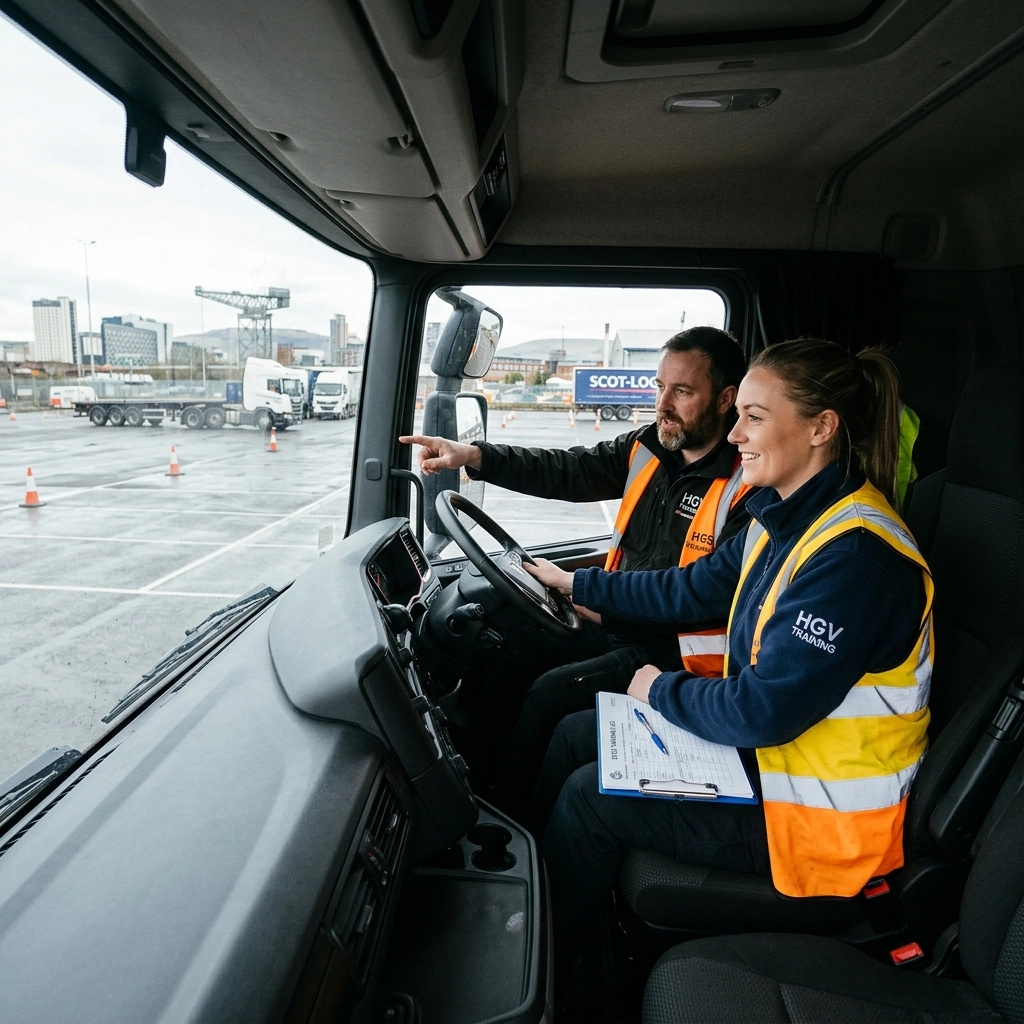
Once your theory is tucked away, you get behind the wheel. During your lgv glasgow practical course, you’ll learn vehicle safety checks, reversing manoeuvres, and how to navigate Glasgow’s unique road layout: from the tight streets of the West End to the high-speed merges of the M8.
Step 4: The CPC (Certificate of Professional Competence)
To drive for a living (and get paid), you must hold a CPC. This involves a practical demonstration (Module 4) where you show an examiner you know how to secure a load and perform safety checks. After this, you will receive your Driver Qualification Card (DQC), which is your "ticket" to the industry.
The Cost of Success: Investing in Your Future
One of the most common questions we get at HGV Training Glasgow is, "How much does it cost?" While prices vary depending on the length of the course and whether you need a full "mop-to-bucket" package, you should view this as an investment rather than an expense.
A full hgv courses scotland package typically covers your medical, theory, practical training, and CPC. While it might cost a few thousand pounds upfront, many drivers find they earn that back within their first few months of full-time employment.
For those worried about the initial outlay, keep an eye out for employer-sponsored training. Many logistics firms in the central belt are so desperate for talent that they will fund your training in exchange for a commitment to work for them. Additionally, the growing opportunity for women in HGV driving has led to various initiatives aimed at diversifying the workforce, sometimes including funded places or grants.

Life on the Road: What to Expect Once You're Qualified
Once you have that shiny new licence, what does the day-to-day actually look like? It’s not all just driving; it’s about responsibility and compliance. You will need to become an expert in drivers' hours and tachograph rules. These rules aren't just red tape: they are there to keep you and everyone else on the road safe by preventing fatigue.
In Glasgow, you might find yourself doing "4 on 4 off" shifts, which many drivers love because it gives them regular, long breaks to spend time with family or pursue hobbies. You might also find that truck stops are improving, offering better facilities for long-distance drivers who are away from home overnight.

Choosing the Right Partner for Your Training
Not all training providers are created equal. When searching for hgv training glasgow, you want a partner that understands the local landscape. You want modern vehicles that reflect what you’ll actually be driving in the real world: not a thirty-year-old lorry that’s seen better days.
At HGV Training Glasgow, we pride ourselves on being approachable and friendly. We know that climbing into a massive Mercedes-Benz Actros for the first time can be intimidating. That’s why our instructors focus on building your confidence as much as your technical skill. We don't just want you to pass the test; we want you to be a safe, competent professional who represents the best of the Scottish transport industry.

Final Thoughts: Get on the Road to a New Career
The road ahead is clear. The logistics industry is the backbone of our country, and as a professional driver, you become a vital link in that chain. Whether you’re delivering life-saving medical supplies to the Queen Elizabeth University Hospital or ensuring the supermarkets stay stocked with our favourite Scottish produce, the work you do matters.
Don't let another year pass by wondering "what if." If you’re ready to take control of your professional future, now is the time to act. From your initial medical to your final CPC module, HGV Training Glasgow is here to support you every mile of the way.
Ready to start your journey? Visit our contact page or explore our latest blog posts for more tips and industry news. Let’s get you behind the wheel and on the road to success!